(415) 550-1077
 San Francisco


Dr. Evan Ransom performs a variety of facial implants for his San Francisco plastic surgery patients. The underlying bone structure of the face plays a major role in facial balance and proportion. Facial implants can strengthen a weak chin, add definition to the cheekbones, and improve the harmony between the upper, middle, and lower face – often with subtle changes that make a significant difference.
Facial implants may be placed on their own or combined with other procedures such as rhinoplasty, facelift, or neck lift. During your consultation, Dr. Ransom will evaluate your facial proportions and help you decide whether a chin implant, cheek implant, or custom implant is the best option for your goals.
Explore our
Patient Gallery
*Actual patients in photos
Chin Implants
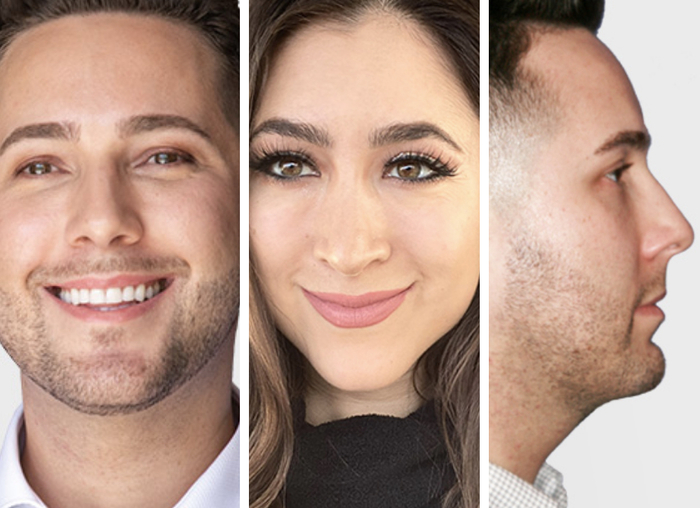
Many patients seek a change to the shape or volume of their chin (genioplasty) alone or in combination with other aesthetic enhancements such as rhinoplasty (“nose job” surgery or nose reshaping) or rhytidectomy (facelift or neck lift). In most cases, the desired procedure is chin augmentation (enlargement). Making the chin bigger or giving it more shape and definition can be achieved with soft tissue fillers, biocompatible implants, or by surgical manipulation of the mandible (lower jaw bone). This procedure can also fill in the depression between the chin and the lower cheek areas along the jawline (sometimes called the pre-jowl sulcus).
Dr. Ransom performs most chin augmentation using biocompatible implants, though soft tissue fillers may be adequate and are selected in some cases. When patients are deciding whether to pursue chin implant surgery, it is sometimes helpful to “try out” an aesthetic change by electing temporary soft-tissue filler augmentation first. Dr. Ransom uses hyaluronic acid-based fillers (Juvederm® or Juvederm Voluma®) or calcium hydroxyapatite-based fillers (Radiesse®) for temporary chin enlargement and to fill the pre-jowl sulcus. With subtle increases in the projection of the chin or the shape and contour of the chin and pre-jowl areas, significant improvements in the harmony between facial areas can be achieved.
Cheek Implants
Many patients seek a change to the shape or volume of their upper cheek area (“cheekbone”, also known as the zygoma or malar eminence), alone or in combination with other aesthetic enhancements such as blepharoplasty (eyelid lift) or rhytidectomy (facelift or neck lift). In most cases, the desired procedure is cheek augmentation (enlargement). Cheek implants may be placed via an incision inside the mouth, between the gums and the upper lip and cheek, or via a lower eyelid incision. This choice is made based on the size of the implant and whether other surgical procedures are being performed concurrently; when no surgery is being performed on the lower eyelid, a trans-oral (by mouth) approach is selected to avoid external incisions.
Modern cheek implants come in many sizes and shapes and can vary in design to include only the upper cheek (malar implants) or the upper and middle cheek (combined malar-submalar implants). Selection of the proper type and size of cheek implant requires a detailed conversation with your surgeon, including analysis of patient photographs or computer-enhanced imaging, and examination of implant types and sizes. Cheek or malar implant surgery can be performed under light sedation and may accompany other cosmetic or reconstructive procedures.
Custom Implants
While standard chin and cheek implants come in a wide range of sizes and shapes, some patients have facial anatomy or aesthetic goals that are best served by an implant designed specifically for them. Custom facial implants are made to match an individual patient’s bone structure, allowing for a precise fit and a result tailored to their unique features. They may be considered for patients with significant facial asymmetry, defects from previous trauma or surgery, or areas such as the jawline that are difficult to address with an off-the-shelf implant.
As with all of his facial implant procedures, Dr. Ransom dedicates a significant amount of time to planning, including a detailed discussion of your goals and careful analysis of your facial proportions. His focus is always on natural-appearing results that enhance your features without looking “done.” Dr. Ransom will discuss whether a custom implant is right for you during your consultation.
Dr. Ransom selects from the most up-to-date implant designs to provide a modern aesthetic for his patients, avoiding extreme changes or unnatural shapes. He uses only biocompatible Silastic (silicone-based) implants, which have the lowest rate of complications of all the available materials.
Who is a candidate?
Candidates for facial implants include:
- Chin implants: Anyone who desires increased projection of the chin, a more defined jawline, or a better neck contour may be a candidate for a chin implant.
- Cheek implants: Anyone who desires increased projection or fullness in the upper cheek area may be a candidate for cheek implants.
Facial implants may be placed as a stand-alone procedure or combined with other aesthetic or reconstructive surgeries. In some cases, implants may be used to camouflage defects from previously healed trauma, including fractures of the maxilla (upper jaw bone) and zygoma. The key to any facial implant surgery is identifying the most appropriate size and shape of the implant – to achieve the greatest aesthetic enhancement, while still looking natural. Dr. Ransom will work closely with you throughout this process.
Download Our Chin Implant Guide
Click below to download all of the information provided on our website in a PDF.

Dr. Ransom, a renowned San Francisco facial plastic surgeon, sees patients from all over Bay Area, including Mill Valley/Marin County, Napa/Sonoma, San Rafael/Petaluma, Hillsborough, San Mateo, Menlo Park, Orinda, Palo Alto, Piedmont, Walnut Creek, and the world.
Frequently Asked Questions
Are silicone chin implants safe?
Are cheek implants dangerous?
How are cheek implants inserted?
How long do jaw implants last?
Can you get jaw implants?
How common are chin implants?
How long do facial implants last?
How do I get rid of my double chins?
What are facial implants made of?
Dr. Evan Ransom is an Ivy League-educated and Ivy League trained Facial Plastic and Reconstructive Surgeon. He is a Double Board Certified Head and Neck Surgeon and Facial Plastic and Reconstructive Surgery and fellowship-trained in facial plastic, reconstructive, and laser surgery. His practice is in the San Francisco Bay Area, serving patients from San Francisco, Oakland, Marin County, Palo Alto, Silicon Valley, Walnut Creek, the East Bay, and all over Northern California.